
Postnatal depression
Postnatal depression treatment in Ireland
Medically reviewed by Dr. Phil Boyle, MICGP, MRCGP · Last reviewed July 2026
Postnatal depression often has a hormonal basis, and at NeoFertility we treat it that way. Delivery causes a steep drop in progesterone, and in women sensitive to that withdrawal, re-introducing progesterone can relieve symptoms directly. In our clinical experience, an antidepressant is not the only treatment option.
That sudden drop is a key hormonal trigger for postnatal mood disturbance, especially in women who are sensitive to it. Re-introducing progesterone addresses the cause directly. For most women, it works. An antidepressant is not your only option.
We see women who are not quite themselves after having a baby. Sleep deprived, managing feeds and unpredictable nights, and the hormonal picture has changed completely.
Some describe it as the baby blues and put their heads down. Others are dealing with something that looks more like clinical depression. You do not need to suffer on.
There is a hormonal explanation for what is happening, and there is a restorative treatment that works for most women.
Cliona, who had three successful NeoFertility pregnancies, also received postnatal depression treatment at NeoFertility. Read her story at Cliona's success story.
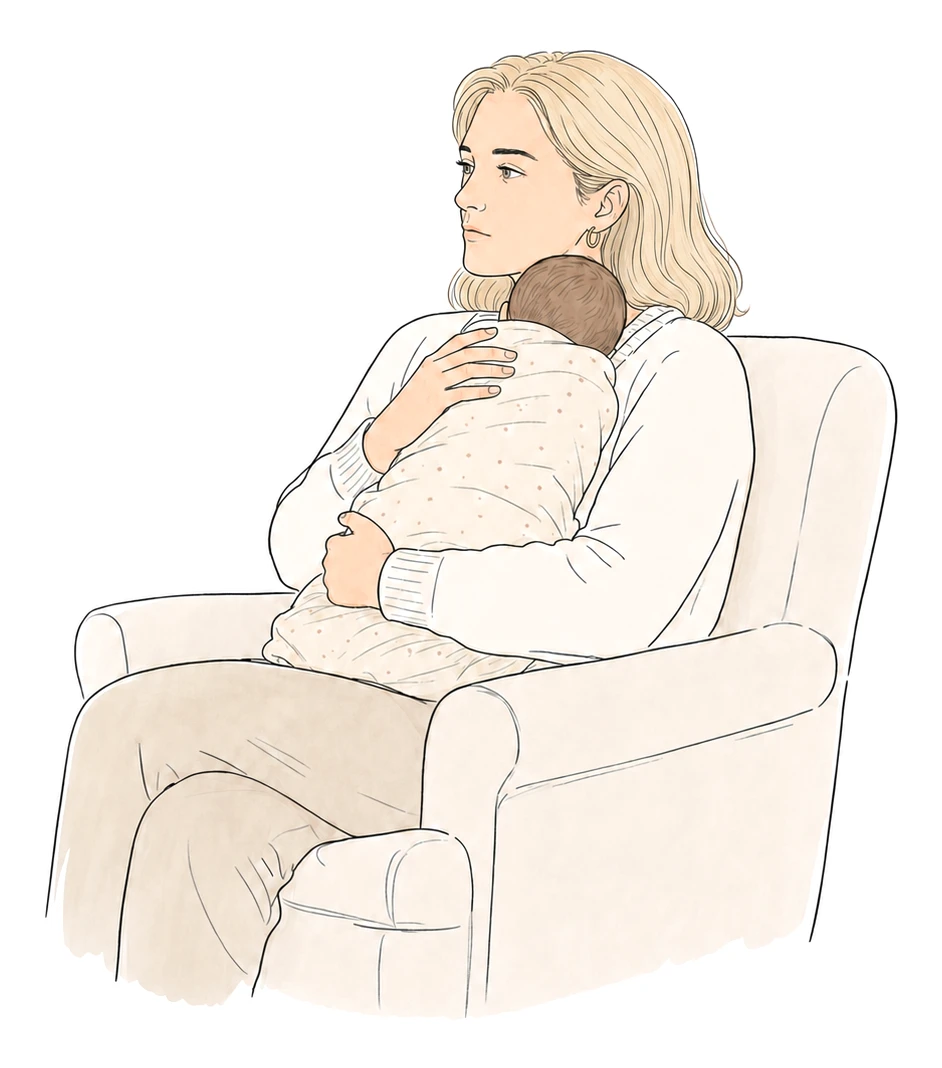
The hormonal mechanism behind postnatal depression
During pregnancy, progesterone rises to levels the body will never see at any other time.
It has a real effect on mood, sleep, and overall wellbeing. Within hours of delivery, that progesterone is gone.
Harris B et al., writing in the BMJ (1994), documented this as part of the Cardiff puerperal mood and hormone study. They linked the sharp hormonal change around birth to maternity blues.
Bloch and colleagues (2000, American Journal of Psychiatry) showed that women with a history of postnatal depression are sensitive to withdrawal of gonadal steroids, including progesterone.
So the baby blues are, in hormonal terms, a predictable withdrawal response. For women more sensitive to that withdrawal, or who had lower progesterone levels to begin with, the response can be severe. This is not a character weakness or a failure to cope.
It is a hormonal event, and it responds to hormonal treatment. Clinical principle
The restorative approach to postnatal depression
So we always start by looking at progesterone.
After delivery, we assess what is happening hormonally and re-introduce progesterone in a form the body recognises. We also look at endorphin function. Low progesterone and low endorphins often go together, and treatment begins there.
Bear in mind, you do not need a diagnosis of postnatal depression to benefit from treatment.
If you are not fully yourself after delivery, if the mood has not lifted the way you expected, if you feel flat rather than well, consider progesterone support and possibly Low Dose Naltrexone. The threshold for getting help here is low, and it should be.
In our clinical experience, progesterone therapy produces marked or moderate improvement in most women with postnatal mood disturbance.
Relief often comes within hours to days. That is a different experience from antidepressants, which typically take weeks to build. We are addressing the underlying hormonal cause.
Low dose naltrexone for postnatal depression
Low Dose Naltrexone, or LDN, works by stimulating the body's own endorphin production.
We describe it as similar but better than a boost of exercise: you get a surge of endorphins and everything just feels better. In our clinical experience, approximately 80% of women respond to LDN with improved mood.
It is well tolerated. The most common side effect is a temporary dry mouth. NeoFertility has treated approximately 2,000 patients with LDN throughout pregnancy.
LDN is just part of ordinary practice at NeoFertility now.
We use it for premenstrual syndrome, for painful periods, and for mood support throughout the reproductive cycle. Postnatal mood disturbance is one more area where it works well.
If you have experienced PMS in the past, that history is useful. It reveals how your endorphin system functions, and helps NeoFertility tailor the approach after delivery.
The beauty of this approach is that NeoFertility is restoring what the body already knows how to do, not introducing a foreign chemical pathway. Read more about LDN for premenstrual syndrome.
Postnatal depression and whole-cycle care
NeoFertility does not stop when the baby arrives.
We treat the full reproductive health picture: the cycle, the pregnancy, and what comes after. Postnatal depression treatment is a direct extension of the care NeoFertility provides during pregnancy.
We already know your hormonal baseline. We have been monitoring it for months. If things do not settle after delivery, NeoFertility is well placed to respond quickly.
If you had a NeoFertility pregnancy, call the practice. If you are coming to us for the first time after delivery, call us as well.
You do not need a referral and you do not need a formal diagnosis. A conversation about how you are feeling and a hormonal assessment is where we start.
Learn more about the NeoFertility treatment approach.
Frequently asked questions
Is progesterone treatment for postnatal depression safe while breastfeeding?
This is one of the first questions we address when a woman comes to us after delivery.
We review the evidence and our clinical experience on a case-by-case basis. The progesterone levels we target are physiological, not pharmacological.
The options are discussed in full at your first appointment. Call the practice and we can talk through your specific situation.
Do I need a formal diagnosis of postnatal depression to be treated?
You do not need a diagnosis of postnatal depression to benefit from progesterone support.
If you are not fully yourself after delivery, that is enough reason to make contact. Many women describe it as a flatness rather than a crisis: low energy, mood that does not lift, not quite recognising yourself.
We can assess what is happening hormonally and start from there.
How quickly does progesterone work for postnatal depression?
In our clinical experience, symptom relief can be quite rapid, often within days.
Nine months of elevated progesterone disappears within hours of delivery. Re-introducing it restores what the body was used to.
It is not a slow build the way antidepressants typically are.
What is Low Dose Naltrexone and why is it used for postnatal depression?
Low Dose Naltrexone, or LDN, works by stimulating the body's own endorphin system. It is similar in effect to a boost of exercise: you get a surge of endorphins and everything just feels better.
We use it alongside progesterone when mood disturbance is significant, or when progesterone support on its own is not enough.
In our clinical experience, approximately 80% of women respond to LDN. It is well tolerated; the most common side effect is a temporary dry mouth. It is just part of ordinary practice at NeoFertility now.
Can NeoFertility help with postnatal depression even if I have already started antidepressants?
Starting an antidepressant does not close the door on hormonal assessment.
We can work alongside your GP. Often we find that restoring progesterone and endorphin function addresses the underlying hormonal cause, and decisions about antidepressants can be revisited over time with your GP's guidance.
The two approaches are not mutually exclusive.