
Polyendocrine metabolic ovarian syndrome, PMOS (formerly PCOS)
PCOS/PMOS treatment in Ireland
Medically reviewed by Dr. Phil Boyle, MICGP, MRCGP · Last reviewed July 2026
PMOS is a hormone condition that can affect periods, fertility, hair growth, mood, weight, and skin. It has no cure, but symptoms can often be managed with lifestyle changes and treatment.
What it is
PMOS stands for polyendocrine metabolic ovarian syndrome, which is the newer name for what was previously called PCOS. It usually starts around puberty, though symptoms vary widely from one female to another.
Common symptoms include:
- Irregular periods or long gaps between periods.
- Difficulty getting pregnant.
- Excess hair growth on the face or body, or hair loss on the scalp.
- Acne, oily skin, tiredness, and weight gain or difficulty losing weight.
- Thick, dark skin patches, especially on the neck or armpits.
Diagnosis
At NeoFertility we diagnose PMOS based on symptoms, blood tests, and an ultrasound scan of the ovaries. The condition can look like other hormone problems, so evaluation is important rather than assuming PMOS from symptoms alone.
Treatment
Treatment options may include cyclical bio-identical progesterone to regulate periods, medicines such as metformin for insulin-related issues, follicle stimulation if pregnancy is wanted, and medicines to reduce unwanted hair growth or acne. Lifestyle changes such as a low carbohydrate diet, regular exercise, and weight loss if needed can also help.
Why follow-up matters
PMOS can increase the risk of type 2 diabetes, high blood pressure, cardiovascular disease, fatty liver disease, and endometrial (womb) cancer, so regular medical review is important. Emotional wellbeing matters too, because anxiety and depression are more common.
Read about our full women's fertility assessment.
If you are reading this, you have probably already been on the pill, already heard about metformin, and already been told that IVF is the only route to a baby.
PMOS treatment in Ireland has historically defaulted to the pill for symptom management and ovulation induction plus IVF for women who want to conceive. NeoFertility takes a different approach.
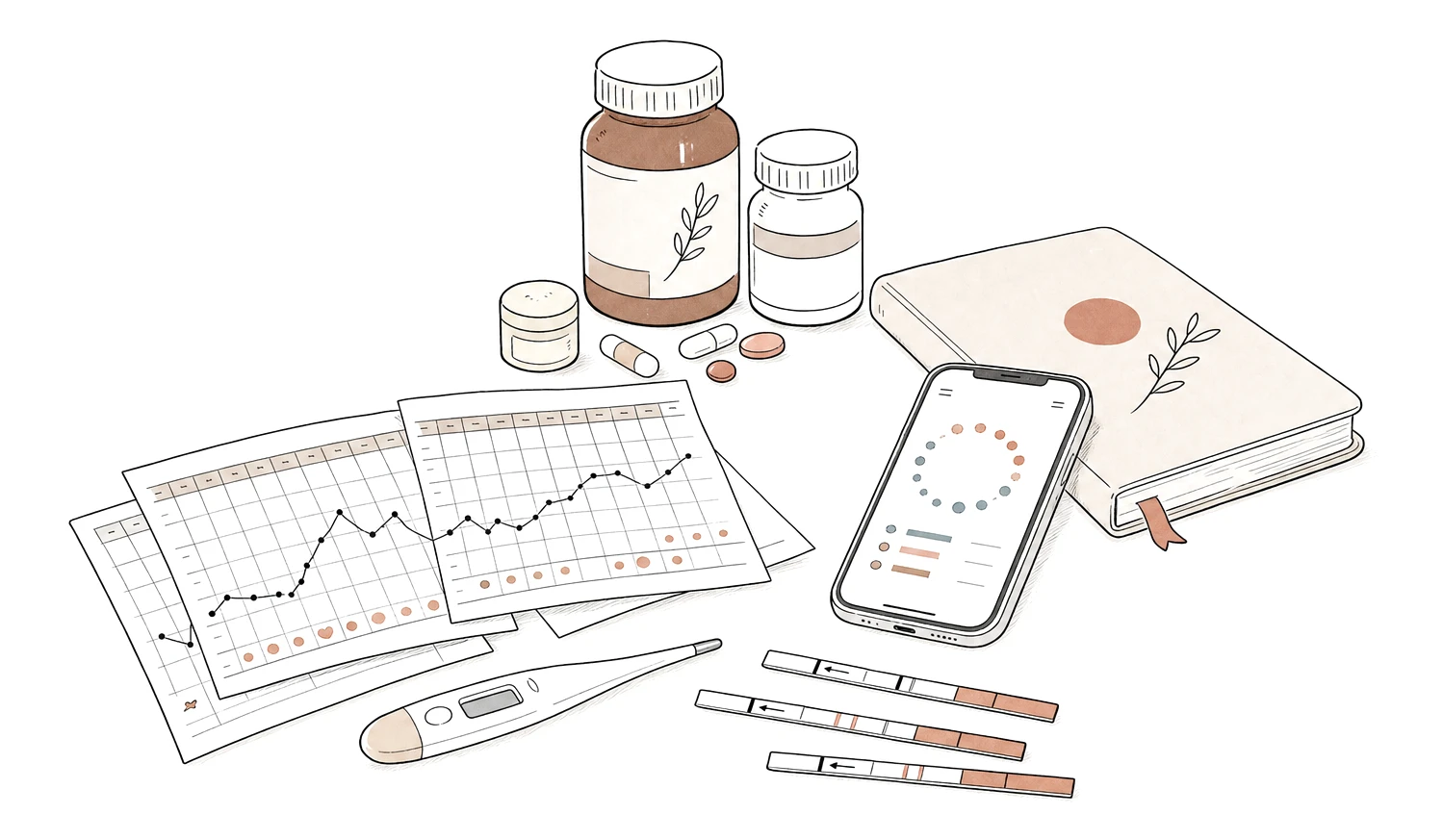
With cycle tracking using the Chart Neo app, timed ultrasound scans and blood tests 7 DPO (days post ovulation) medications are titrated to achieve an optimal balanced cycle and healthy metabolism to enhance conditions for conception. This YouTube presentation explains how NeoFertility treatment of PMOS is significantly different from conventional treatment, despite using many medications in common.
What is PMOS (PCOS)?
PMOS is one of the most common hormonal conditions in women of reproductive age.
It is marked by elevated luteinising hormone, elevated androgens, and insulin resistance that together disrupt normal follicle development and ovulation. If you have PMOS, you probably know what irregular, unpredictable cycles feel like. Being told that is just how it is does not help.
Diagnosis is made when at least two of three Rotterdam consensus criteria are met.
A clinician looks for at least two of the following: a cycle that is not ovulating regularly, signs of elevated androgens such as acne, excess hair growth, or hair thinning, and a polycystic appearance of the ovaries on ultrasound.
Not every woman with cysts on a scan has PMOS. The condition is the combination, not the scan alone.
PMOS is not primarily a fertility condition, though impaired fertility is often what brings women to us. If you have PMOS, you have probably lived with some combination of irregular cycles, acne, unwanted hair growth, difficulty managing weight, and concerns about long-term metabolic risk.
These deserve proper investigation and treatment whether or not conception is the immediate aim.
Women can present with PMOS from adolescence onward, years before they are thinking about pregnancy. What is sometimes labelled unexplained infertility by another clinic turns out, on proper investigation, to be PMOS sitting behind the label.
Why the standard approach does not fix PMOS/PCOS
The most common first response to a PMOS diagnosis is the contraceptive pill.
Many women reading this were put on it at 16 or 17, for acne or for heavy periods, and were never told the underlying condition would still be there when the pill was stopped.
The pill reduces androgen levels, brings a degree of cycle regularity, and manages acne and hirsutism. For some women in particular circumstances it is the right short-term tool.
But it works by suppressing the natural cycle and replacing it with a medicated bleed. When the pill is stopped, the hormonal environment that was driving the problem is still there. The PMOS was held in place, not corrected.
If you are still on the pill now, that is not a failing on your part. It is what you were offered, and we will take it from wherever you are.
Metformin is the other common first-line offering. It can genuinely help women with documented insulin resistance, and we use it in those circumstances.
The issue is that it is frequently handed out on the basis of the PMOS label rather than after a test confirming insulin resistance is actually present.
A drug given without measuring the thing it is supposed to correct is not a clinical protocol; it is a placeholder.
For women trying to conceive, the standard path in many clinics and IVF units is ovulation induction followed by IUI or IVF.
PMOS patients on IVF stimulation protocols carry an elevated risk of ovarian hyperstimulation syndrome (OHSS). OHSS can range from uncomfortable to medically serious.
A single round of IVF in Ireland typically costs EUR 5,000 to EUR 8,000, and most couples require more than one round. Per HFEA data, the overall average IVF live birth rate per treatment cycle is only 27% (2024 data published June 2026).
The question we ask is whether IVF is necessary if the underlying condition can be treated instead.
In the 2019 NeoFertility cohort study (Boyle et al., JRRM 2025), only 2% of couples who started treatment went on to discontinue it. Published data on IVF shows discontinuation rates exceeding 65%, most commonly due to emotional burden, side effects, and cost.
What drives PMOS/PCOS
In PMOS, luteinising hormone (LH) stays elevated throughout the cycle instead of producing a clean mid-cycle peak.
This shifts the ovaries toward androgen production rather than normal follicle development. Follicles begin growing but stall before ovulation, which is the origin of the "polycystic" description on ultrasound. Those multiple small follicles are a downstream finding, not the cause.
The cause is the hormonal signalling that is keeping them from maturing.
Insulin resistance amplifies the problem. When insulin levels are chronically elevated, the ovaries produce more androgens, which further disrupts follicle development. Farrell and Antoni, writing in Fertility and Sterility (2010), documented these biobehavioural mechanisms (Farrell K, Antoni MH, Fertil Steril, 2010; DOI: 10.1016/j.fertnstert.2010.03.081; PMID 20471009).
Elevated insulin drives androgen overproduction via suppression of sex hormone binding globulin and direct stimulation of ovarian androgen biosynthesis. In Dr. Boyle's clinical experience, this insulin resistance link is common across all body types.
If you are slim, or a normal BMI, and have been told that rules out PMOS or rules out insulin resistance, it does not. We test for it in every PMOS patient regardless of weight.
The elevated androgens that result, including elevated free and total testosterone and elevated DHEAS, are not just a fertility issue. They contribute to acne, hirsutism, hair loss, and over time they raise cardiometabolic risk.
Approximately 75% of women with PMOS experience infertility due to anovulation; PMOS is the most common cause of anovulatory infertility (Costello et al., ANZJOG, 2019). Treating only the fertility symptom without addressing the metabolic and hormonal drivers means the underlying condition continues uncorrected.
What the PMOS/PCOS investigation covers
The investigation starts with the fertility chart.
ChartNeo is NeoFertility's fertility charting app, supporting Billings, Creighton, Sympto-Thermal, and Marquette methods, used to map the cycle from the first appointment.
So what we do is look at whether the cycle is trying to ovulate at all, whether ovulation is being delayed, and whether it is followed by good hormonal support. That context guides the blood work.
Timed blood tests are run across the cycle, not just a snapshot on day 3 or day 21. Day-21 progesterone testing only tells you whether ovulation may have occurred. It does not tell you whether the ovulation was of good quality.
The 7 DPO blood protocol measures progesterone and oestradiol on the 6th to 9th day after ovulation, as identified from charting.
The target is progesterone above 60 nmol/L and oestradiol above 400 pmol/L at that point. In PCOS patients the following are also measured as part of the investigation:
- LH/FSH ratio and mid-cycle LH pattern
- Free and total testosterone, DHEAS
- Fasting insulin
- Sex hormone binding globulin (SHBG)
- AMH, thyroid markers, prolactin
Male factor assessment begins at the first appointment. Male factor is present in a significant proportion of couples with impaired fertility. PMOS on one side does not rule it out on the other. Both partners are assessed from day one.
This is part of the NeoFertility treatment plan; the full three-phase approach is described there.
PMOS/PCOS treatment: the restorative approach
Treatment is multi-factorial and tuned to what the investigation actually found.
There is no single PMOS protocol because the drivers are not identical between women. What we use depends on what we measured.
Dr. Agnes Toth is a consultant obstetrician and gynaecologist at NeoFertility with a particular clinical interest in insulin resistance and its role in reproductive health. She works alongside Dr. Boyle in assessing and treating women where insulin resistance and inflammatory markers are significant contributors.
For insulin resistance, the evidence base supports both myo-inositol and metformin. Fruzzetti and colleagues ran a randomised controlled trial of 50 women with PMOS comparing the two (Fruzzetti F et al., Gynecol Endocrinol, 2017; DOI: 10.1080/09513590.2016.1236078; PMID 27808588).
In Dr. Boyle's clinical experience, myo-inositol carries a more favourable side-effect profile for most patients. For women with mild to moderate insulin resistance, it is often our first-line choice. Where metformin is indicated, we use it.
The aim is one good follicle per cycle, not 8 to 12. NeoFertility approach
Beyond insulin sensitisation, treatment may include:
- Targeted cycle support to restore ovulation, timed to the individual cycle pattern and guided by charting.
- Luteal phase progesterone support after ovulation, where 7 DPO blood tests confirm suboptimal luteal function. Bear in mind that the quality of ovulation matters as much as the fact of it.
- Dietary and lifestyle guidance framed around insulin sensitivity and metabolic health rather than a BMI target. The goal is to improve how the body handles insulin, which is the mechanism that drives PMOS, not a weight number on a chart. We do not decline patients on BMI, and we do not require weight loss before treatment starts.
- Low Dose Naltrexone (LDN) where immune dysregulation or symptoms of clinical endorphin deficiency are present. In our published 2019 cohort (Boyle et al., JRRM 2025), 71% of all couples received LDN as part of their pre-conception treatment. For PCOS patients specifically, LDN is one option we consider case by case, not a default protocol.
Treatment is a process over time, typically months to a year to fully restore hormonal balance. The goal is regular, good-quality ovulation whether or not conception is the immediate aim.
PMOS/PCOS and fertility
PMOS is the most common cause of anovulatory infertility.
Approximately 75% of women with PMOS experience infertility due to anovulation (Costello et al., ANZJOG, 2019). In practical terms, the ovaries are producing follicles that are not maturing through to release an egg.
The treatment path is to restore that process, not to bypass it with IVF.
So what does restoring ovulation actually look like? The cycle returns to a predictable, ovulatory pattern. That pattern is confirmed by two independent lines of evidence. The fertility chart shows the mucus pattern and temperature shift associated with ovulation.
The 7 DPO blood tests confirm the progesterone and oestradiol levels the body is producing to support that ovulation.
When those numbers come into range, the cycle is doing what it should, and natural conception becomes possible. You are not being asked to take our word for it. The chart and the blood work suggest the treatment is working, but follicle rupture by ultrasound scan proves it. Ultrasound is key.
In our published 2019 cohort of 187 couples (Boyle et al., JRRM 2025), the conception rate was 52% and the crude live birth rate was 41%. These are cohort-wide figures, not specific to PMOS patients, and you can review our published results in full.
We do not selectively report. Many of the couples who come to us having been told IVF is their only option go on to conceive naturally. That is not a promise. It is a pattern we see repeatedly in our patient stories.
For couples who do conceive, support continues. We start progesterone support right away, monitor with weekly blood tests in the first three weeks of pregnancy, then every two weeks from 8 to 12 weeks, and monthly thereafter. The first pregnancy scan is at 7.5 weeks.
See our 3-phase approach for the full plan.
PMOS/PCOS beyond fertility
PMOS is not just a fertility problem.
It is a whole-body hormonal and metabolic condition. Irregular cycles, acne, hirsutism, and difficulty managing weight all deserve proper treatment. So do the longer-term risks: insulin resistance that can progress toward type 2 diabetes, and elevated cardiovascular risk.
None of this requires fertility to be the presenting concern.
Women in their 20s and early 30s can start restorative reproductive medicine years before conception is a question. Finding and correcting insulin resistance and androgen excess earlier in life reduces long-term metabolic risk and improves quality of life in the meantime.
It is not necessary to wait until fertility is the presenting concern.
NeoFertility offers a women's health appointment (EUR 100, 20 minutes) for women who want a PMOS assessment without the full fertility workup.
This is the starting point for women who are not currently trying to conceive but want to understand what is driving their cycle irregularity, acne, or weight struggles. For broader hormonal questions beyond PMOS, the hormonal dysfunction page covers related conditions.
Starting PMOS/PCOS treatment at NeoFertility
Your first appointment is 45 minutes with either Dr. Boyle or Dr. Agnes Toth.
Dr. Toth has a particular focus on insulin resistance and its role in reproductive health. You do not need a GP referral. ChartNeo charting starts from the first appointment so that the first blood tests already have cycle context.
Dr. Phil Boyle is the founder of NeoFertility and president of the International Institute for Restorative Reproductive Medicine (IIRRM). Both Dr. Boyle and Dr. Toth see PMOS patients.
The appointment you book will match you to the right clinician based on your presenting concern and availability.
For detail on treatment plan cost and what is included, see the treatment plan cost page. A single round of IVF in Ireland typically costs EUR 5,000 to EUR 8,000. The NeoFertility treatment plan covers up to 12 balanced cycles at a fraction of that cost.
To book your first consultation, you can self-refer directly through our booking page. No referral letter needed.
Frequently asked questions
Do I have PMOS/PCOS?
PMOS is diagnosed when at least two of three criteria are present: irregular or absent periods, signs of elevated androgens such as acne, excess hair growth, or hair loss, and a polycystic appearance of the ovaries on ultrasound. This is called the Rotterdam consensus.
Not every woman with cysts visible on a scan has PMOS. The condition is the combination of findings, not the scan alone.
If your periods are irregular, you have noticed hormonal symptoms, or a scan has flagged something, a proper investigation at NeoFertility can give you a clear answer.
Can I get pregnant with PMOS/PCOS?
In most cases, yes. PMOS is one of the most common causes of anovulatory infertility, and in our clinical experience it is also one of the most treatable once the underlying hormonal and metabolic causes are properly addressed.
Approximately 75% of women with PMOS experience infertility due to anovulation (Costello et al., ANZJOG, 2019). The restorative treatment approach aims to restore regular, good-quality ovulation, which is what most women need for natural conception to happen.
When ovulation is restored and confirmed by charting and 7 days post ovulation (7 DPO) blood tests, most women with PMOS do not need IVF. See our treatment plan for how the process works.
Do I need metformin for PMOS/PCOS?
Not necessarily. Metformin is a useful medication for women with documented insulin resistance, and we use it where the blood results show that. But it should follow a proper test, not be handed out on the basis of a PMOS label alone.
If you are currently on metformin and it is helping, that is not a problem. We will look at your blood results and decide together whether to continue, adjust, or change.
For women with mild to moderate insulin resistance, myo-inositol is often our first-line choice. Both have published evidence in PMOS. Where metformin is the right tool, we use it; where it is not, we do not.
What about weight loss? I have been told to lose weight before being treated.
If you have been told to lose weight before anyone will help you, you are not alone, and we understand how demoralising that advice can feel.
We do not require weight loss before treatment begins. Investigation and treatment start right away and run in parallel with whatever plan is clinically relevant for that woman. We do not have a BMI cut-off.
Insulin resistance and hormonal imbalance can be present in women of any weight and respond to treatment regardless of BMI. Where weight is a contributing factor, we address it through insulin sensitivity and metabolic health, not as a gate to being seen.
Will I need IVF for PMOS/PCOS?
Most women with PMOS who come to us do not need IVF. PMOS-driven infertility is usually anovulatory, which means the treatment path is to restore ovulation, not to bypass it.
IVF stimulation protocols also carry an elevated risk of ovarian hyperstimulation syndrome (OHSS) in PCOS patients, which is another reason we aim to avoid them where possible. Our aim is one good follicle per cycle, not 8 to 12.
Many couples with PMOS who come to us, having been told IVF is their only option, go on to conceive naturally after restorative treatment. A single round of IVF in Ireland typically costs EUR 5,000 to EUR 8,000.
Our treatment plan is available at a fraction of that cost; see our pricing page for detail.
Is the contraceptive pill a treatment for PMOS/PCOS?
The contraceptive pill is commonly prescribed to manage PMOS symptoms such as irregular periods, acne, and excess hair growth. It can be the right short-term tool for some women.
If you were put on the pill in your teens or twenties and stayed on it for years, you are not alone. It is what most women with PMOS are offered first.
But it suppresses the natural cycle rather than correcting what is driving the imbalance.
When the pill is stopped, the PMOS is still there, exactly as it was. Our approach is to find and treat the underlying hormonal and metabolic causes so the body can regulate its own cycle.
Can I be treated for PCOS/PMOS if I am not trying to conceive?
PMOS treatment does not require fertility to be your current concern. PMOS affects whole-body health: metabolic risk, cycle regularity, acne, hirsutism, and mood. These deserve proper treatment whether or not fertility is the question right now.
We offer a women's health appointment (EUR 100, 20 minutes) for women who want a PMOS assessment without the full fertility workup. Many women start restorative treatment in their 20s or early 30s, years before conception is a question.
If you have been told you have PMOS and are not sure where to go with it, that appointment is a good starting point.