
Fertility after 35
Fertility after 35 in Ireland: what the data actually shows
Medically reviewed by Dr. Phil Boyle, MICGP, MRCGP · Last reviewed June 2026
Fertility declines with age, but age is rarely the whole story. At NeoFertility, we assess what is actually limiting conception in each couple and treat the underlying cause. For most women we see over 35, there is a specific cause that can be identified and addressed.
If your GP or gynaecologist has told you age is the problem and IVF is the next step, you are in the same position as most women who come to NeoFertility for the first time.
If you have seen your AMH number and felt the floor drop out, you are in good company. What we find, more often than not, is that the hormonal environment and the quality of ovulation are both contributing. Those are treatable.
Read how Michelle welcomed her son in her early forties after stage 4 endometriosis, two miscarriages, and being told donor eggs with IVF was her only option.
Fertility after 35 in Ireland is not a single story, and it is rarely as simple as "your age is the reason."
Restorative fertility treatment is medical care that identifies and corrects the underlying conditions of a couple's impaired fertility, including those that come alongside advanced maternal age. The NeoFertility method looks at hormonal, ovulatory, and structural factors in both partners and treats the findings directly.
Most of the women in NeoFertility's reported cohorts are already over 35.

Two things change after 35, and one of them is treatable
We are not going to tell you that age does not matter.
Advanced maternal age, clinically defined as pregnancy at or after 35 years, increases the rate of egg chromosomal abnormality and reduces ovarian reserve. This is the genetic side of ageing.
It does not by itself rule out natural conception or restorative fertility treatment, but it is real, and we do not minimise it.
The second change is physiological. The hormonal environment around ovulation, the quality of the follicle, and luteal phase support can all decline after 35. That is where restorative fertility treatment works.
We target progesterone above 60 nmol/L and oestradiol above 400 pmol/L, measured at 7 DPO. That timed blood draw, the 7 DPO test, tells us the quality of ovulation in a way that a standard day-21 progesterone test cannot.
The day-21 test is a limited view of luteal function. 7 DPO is specific and actionable.
Age also raises the question of AMH, the anti-Mullerian hormone marker for ovarian reserve. AMH declines with age and is often the number a woman is given when she is told to move toward donor eggs.
If you have been handed an AMH result and a donor-egg recommendation in the same appointment, you are not alone. AMH is assessed in context at NeoFertility, alongside the full hormonal picture, not on its own. See how we interpret low AMH.
Published cohort data: NeoFertility's average patient is already over 35
This matters for how you read the outcome data.
NeoFertility cohorts are not cherry-picked with younger patients. The women in these cohorts are already in the position you are in.
In the 2019 cohort, published in peer-reviewed form as Boyle et al., JRRM 2025, the average female age was 36.4 years, the average male age was 38.0 years, and couples had been trying for an average of 32.2 months.
The crude live birth rate was 41% (77 of 187 couples), with follow-up to 32 months. This includes all couples who committed to the treatment programme, including those who did not conceive. (Peer-reviewed: Boyle et al., JRRM 2025. 187 couples. Mean female age 36.4.)
If you are 36, or 38, or 41, and you are reading this after another negative test, the woman next to the number in that denominator looks a lot like you.
In a 2015 clinic audit of 412 couples, the average female age was 37 and 21% had prior failed IVF. The adjusted live birth rate at 24 months, calculated using life table analysis (the same method IVF researchers use), was 53.6%.
The adjusted rate at 12 months was 35%, at 18 months 45%, and at 24 months 53.6%. The multiple pregnancy rate was under 1%: one triplet and zero twins. (2015 clinic audit, not peer-reviewed. 412 couples. Average female age 37. 21% prior IVF.)
How do you read these two figures together? The 41% is from a peer-reviewed paper published in 2025, reflecting a more recent cohort. It is the crude rate: every couple who committed to treatment is in the denominator.
The 53.6% is from a clinic audit, not a peer-reviewed study, and uses life table analysis over 24 months. They are different measurements, and we do not mix them in a single claim.
What they share: in both cohorts, the average woman was already over 35. These are real numbers from real patients.
For the full outcome data, see the published results.
What the fertility assessment covers at your age
So what we do is we look at the mucus pattern, we look at the hormones, we look at the ultrasound timing.
We assess both partners from the outset, so you are not carrying this investigation alone.
The goal of Phase 1 is to find what has not been found yet. In the 2019 peer-reviewed cohort (Boyle et al., JRRM 2025), what had been labelled unexplained infertility dropped from 24% at first presentation to 1% after the full NeoFertility workup.
The cause was there. It simply had not been investigated.
The assessment covers several categories:
- Quality of ovulation: progesterone and oestradiol at 7 DPO, targeting above 60 nmol/L and above 400 pmol/L respectively. Confirmed follicle rupture by ultrasound, not simply presumed. In Dr. Boyle's clinical experience, about 8 out of 10 couples with impaired fertility show suboptimal ovulations when properly assessed at 7 DPO. This is clinical experience, not a published trial result, but it is what we see consistently.
- Hormonal reserve: AMH in context, alongside DHEA and adrenal function, thyroid, and androgen levels. Low DHEA is an underdiagnosed finding in women over 35 and is both correctable and relevant to miscarriage risk. For the specific low-AMH picture, see how we interpret low AMH.
- Endometriosis and structural factors: endometriosis is present in 60% of patients who had laparoscopy or hysteroscopy in the 2019 cohort (Boyle et al., JRRM 2025). It is often the silent condition nobody has looked for properly. For more detail see endometriosis treatment.
- Male partner: semen analysis, DNA fragmentation, and hormonal profile from day one. The male partner is assessed at the same time, not as an afterthought.
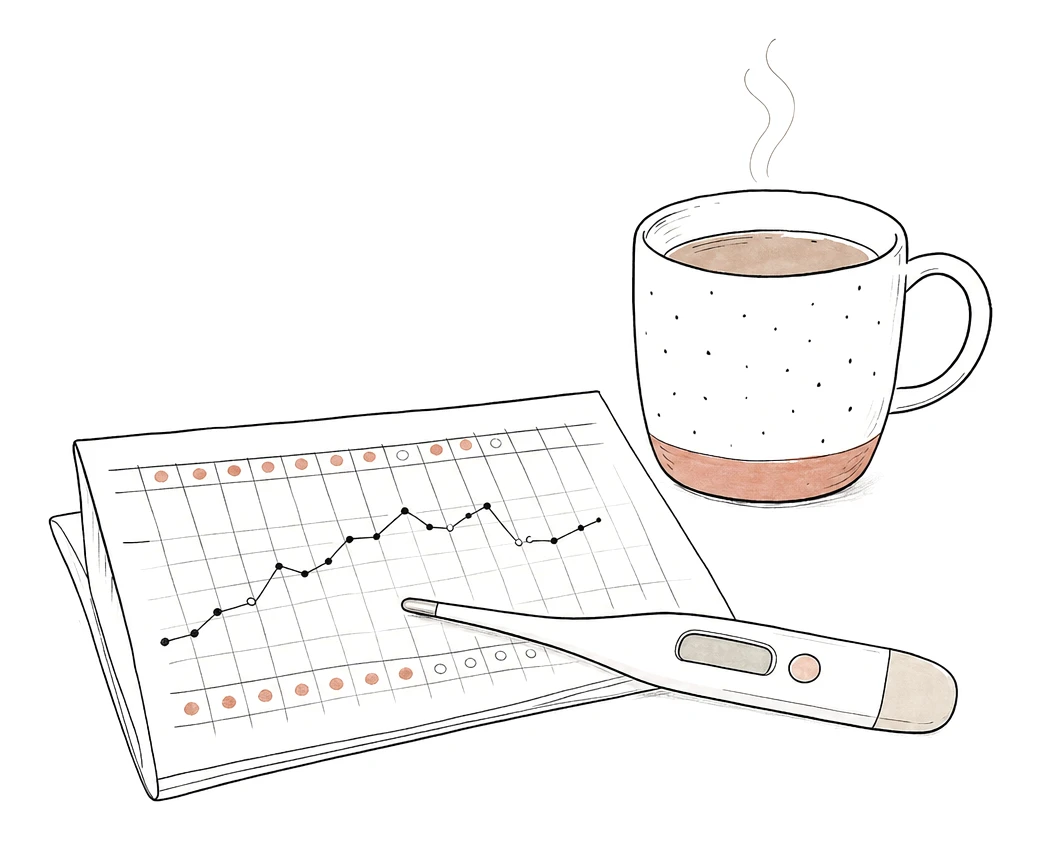
- Fertility charting: the chart pattern before the first consultation reveals pre-conception biomarkers that we cannot get from a blood test alone. ChartNeo, our fertility charting app, generates this picture before you arrive.
The results of Phase 1 directly shape the treatment plan in Phase 2 and Phase 3. For the full structure, see the three-phase treatment plan.
Should you just skip to IVF?
We hear this question every week, and it deserves a direct answer.
The first reason not to skip straight to IVF is that IVF does not investigate or correct the hormonal environment. A suboptimal progesterone at 7 DPO, a short luteal phase, or an undiagnosed endometriosis picture will still be there after embryo transfer.
The IVF cycle works around those problems. It does not remove them.
So a couple with an untreated hormonal picture going into IVF carries a disadvantage the procedure cannot fix. The overall IVF live birth rate per treatment cycle in the UK was 26.4% (HFEA 2017). Roughly three in every four IVF cycles end without a baby.
Those are the published figures. What they do not capture is whether the hormonal environment going into each cycle was properly assessed, or whether addressing it would have changed the result.
If you are reading this after a failed IVF cycle, you are not imagining how empty that diagnostic silence feels. The second reason is the data on couples who have already been through IVF.
In a peer-reviewed cohort of 403 couples who had all previously failed IVF, the adjusted live birth rate with restorative treatment was 32.1% (Boyle et al., Frontiers in Medicine 2018).
That cohort had a mean female age of 37.2 years and an average of 2.1 prior IVF or ART cycles. Age-stratified figures: 37.0% for women aged 35 to 37, 28.1% for women aged 38 to 40, 27.0% for women over 40.
These couples had not run out of options. They had not yet been properly assessed.
The cost question is real. A single IVF cycle in Ireland typically costs EUR 5,000 to EUR 8,000. The NeoFertility treatment plan, covering up to 12 balanced cycles of consultations, hormone panels, follicle scans, and clinical support, costs a fraction of that.
Read how Niamh and David had two NeoFertility babies after three failed IVF cycles and being told to consider donor eggs. See treatment plan cost.
What about donor eggs?
Most couples who arrive with a donor-egg recommendation have not had a full hormonal workup.
That is the honest starting point. In Dr. Boyle's clinical experience, donor treatment is typically suggested before the hormonal environment has been properly assessed.
What we look at in that workup: the quality of ovulation at 7 DPO, DHEA and adrenal function, thyroid, the endometrial picture, and the male partner on day one.
Among the couples we see who have been told donor eggs are the next step, a treatable finding is the rule, not the exception. Suboptimal ovulation, low DHEA, or untreated thyroid dysfunction are common. The investigation was never done. That is the honest problem.
Bear in mind the 2015 clinic audit sub-cohort: 26 couples with AMH below 3.5 pmol/L, the level at which donor eggs are often raised as the only path.
The live birth rate in that group was 35%, with zero preterm deliveries and zero multiple pregnancies (2015 clinic audit, not peer-reviewed; small cohort). The IVF procedure needs many eggs per cycle because egg retrieval is the starting point of the procedure.
That is a different question from the one we ask: what is stopping this couple's one good egg from making it through? See how we interpret low AMH for more detail on what that assessment involves.
A single egg is all that is needed for a natural conception. NeoFertility approach
We are not going to string you along. If we investigate and the picture genuinely cannot be supported, we will say so. That honesty is the entire basis for doing the investigation.
But the scenario where we reach that conclusion after a full workup is uncommon in the cohort referred to us with donor-egg recommendations. The investigation itself answers the question.
Is it safer to have a baby at this age?
Background obstetric risks do rise with maternal age, and we are not going to pretend otherwise.
What we can tell you is what the hormonal environment and close pregnancy monitoring contribute to the outcome picture. Those are two things we can actually do something about.
In the 2019 peer-reviewed cohort (Boyle et al., JRRM 2025), the singleton prematurity rate was 4.0%, compared with 11.8% in CDC IVF data. Singleton low birth weight was 5.3%, also compared with 11.8% in IVF.
The twin rate was 2.5%, compared with 6 to 7% in IVF data. These are outcomes in a cohort where the hormonal environment was assessed and supported before conception and monitored throughout pregnancy.
Pregnancy support begins the moment a positive test is confirmed. Progesterone and oestradiol support starts immediately, not at a 6-week booking appointment. We schedule weekly blood tests in the first three weeks of pregnancy, then fortnightly to 12 weeks, and monthly thereafter.
The first pregnancy scan is at around 7 to 8 weeks, because a scan at 6 weeks can be falsely reassuring. A follow-up scan at 10 weeks confirms ongoing viability. The care does not stop at 12 weeks.
How long do I have to figure this out?
The window for investigation is narrower after 35, and we move accordingly.
One charting cycle plus the 7 DPO blood draw gives us a clear initial picture in 4 to 6 weeks. Phase 1 overall takes about 2 months. This is not an extended waiting period.
It is an active investigation that produces diagnostic information at each step.
Bear in mind, the data tells us something important about time and persistence. Treatment is a process over time.
In the 2019 peer-reviewed cohort (Boyle et al., JRRM 2025), the average time from starting treatment to a live birth was 12 months, plus or minus 8 months. The longest was 32 months.
The life table analysis of the 2015 cohort shows 35% at 12 months, 45% at 18 months, and 53.6% at 24 months. Staying the course matters, and the data is clear that extending the time horizon substantially improves the cumulative outcome.
If you are over 35, have been trying for more than 6 months, or have been given an AMH number without a full hormonal workup, the next step is a first consultation. You do not need a GP referral.
You do not need to have been trying for years. You do not need to have already decided that NeoFertility is for you. Book your first consultation directly.
And if you want to read one story first, read how Michelle met her son in her early forties.
Dr. Phil Boyle is the founder of NeoFertility and president of the International Institute for Restorative Reproductive Medicine (IIRRM). His clinic has treated a cohort with an average female age of 36.4 years in the most recent published paper.
The International Institute for Restorative Reproductive Medicine (IIRRM) is an international body of clinicians advancing evidence-based restorative treatments.
Frequently asked questions
Am I too late to conceive naturally after 35?
We hear this question every week, and the short answer is no.
In our most recent peer-reviewed cohort of 187 couples, the average female age was 36.4 years and the crude live birth rate was 41%, with follow-up to 32 months (Boyle et al., JRRM 2025).
Age is a real factor in fertility, and we do not pretend otherwise. But in the great majority of women we see, it is not the whole story.
There are two mechanisms behind age-related fertility decline. The first is genetic: egg chromosomal abnormality rises with age, and no treatment reverses this. The second is the hormonal environment around ovulation and luteal phase support. That is precisely where restorative treatment works.
Should I skip straight to IVF because of my age?
Not necessarily, and for two specific reasons.
First, IVF does not diagnose or correct the hormonal environment. A suboptimal luteal phase, a progesterone deficiency, or undiagnosed endometriosis will still be present after embryo transfer.
Second, Dr. Boyle's published outcomes for couples who had already been through IVF are comparable with published IVF results.
In a peer-reviewed cohort of 403 couples who had previously failed IVF (mean female age 37.2, average 2.1 prior IVF or ART cycles), the adjusted live birth rate with restorative treatment was 32.1% (Boyle et al., Frontiers in Medicine 2018).
These couples had not run out of options.
A single round of IVF in Ireland typically costs EUR 5,000 to EUR 8,000 per cycle. Before committing to that, it is worth knowing what the investigation finds. See our treatment plan cost.
What about donor eggs? I have been told my AMH is too low.
We hear this one regularly. In our clinical experience, donor treatment is typically suggested before the hormonal environment has been properly assessed.
Among the couples we see who arrive with a donor-egg recommendation, a treatable finding is the rule: suboptimal ovulation, low DHEA, or thyroid dysfunction that has not been looked at properly.
In a 2015 clinic audit sub-cohort of 26 couples with AMH below 3.5 pmol/L, the live birth rate was 35%, with zero preterm deliveries and zero multiple pregnancies (2015 clinic audit, not a peer-reviewed paper; small sample).
Low AMH is a marker worth knowing, but it is not a verdict.
The IVF procedure needs many eggs per cycle. Natural conception needs one. If we investigate and the hormonal environment genuinely cannot be supported, we will say so directly. See how we interpret low AMH.
Is it safer to have a baby after 35 with NeoFertility support?
Background obstetric risks do rise with maternal age, and we do not minimise that.
What we can tell you is what our published cohort data shows. In the 2019 peer-reviewed cohort (Boyle et al., JRRM 2025), our singleton prematurity rate was 4.0%, compared with 11.8% in CDC IVF data. Singleton low birth weight was 5.3% versus 11.8% in IVF.
The twin rate was 2.5%.
We schedule the first pregnancy scan at around 7 to 8 weeks. A scan at 6 weeks can be falsely reassuring. Weekly bloods in the first three weeks of pregnancy, then fortnightly to 12 weeks, are part of our standard pregnancy support.
You will not be handed off at the 12-week scan.
How long do I have to figure this out?
The window for investigation is narrower after 35, so we move quickly. We do not waste your time.
Seven days post ovulation (7 DPO) testing and one cycle of charting gives us a clear picture in 4 to 6 weeks. Phase 1 overall takes about 2 months.
In our 2019 peer-reviewed cohort (Boyle et al., JRRM 2025), the average time from starting treatment to a live birth was 12 months, plus or minus 8 months. Staying the course matters. See the three-phase treatment plan for the full structure.
What is the assessment at NeoFertility actually like at my age?
We look at the full picture for both partners from the first consultation. You are not carrying the investigation alone.
We assess the fertility charting pattern, progesterone and oestradiol at 7 DPO (our target is above 60 nmol/L for progesterone and above 400 pmol/L for oestradiol), and ultrasound confirmation that the follicle has actually ruptured.
We also look at AMH in context rather than on its own, DHEA and adrenal function, thyroid, and the male partner from day one.
In Dr. Boyle's clinical experience, about 8 out of 10 couples with impaired fertility show suboptimal ovulations when properly assessed at 7 DPO. The day-21 progesterone test tells us only whether you ovulated at all.
The 7 DPO test tells us the quality of that ovulation. See the three-phase treatment plan.
Have you treated women successfully at my age?
In both of Dr. Boyle's reported cohorts, women over 35 are the majority. The peer-reviewed 2019 cohort has a mean female age of 36.4 (Boyle et al., JRRM 2025). The 2015 clinic audit cohort had an average female age of 37.
Read Michelle and Brian's story: Michelle conceived naturally and welcomed a healthy baby in her early forties after stage 4 endometriosis, two miscarriages, and being told donor eggs with IVF was her only option.
Read also our full success stories. There are percentages, and then there are people.